

How to Choose Matching Wedding Ring Sets for Two
Matching wedding ring sets sound simple: two rings, one look. In practice, "matching" can mean three different things, and choosing the wrong one is the most common regret we hear about. Here is how we think about it.
Matching, or coordinating?
A truly matching set uses the same metal, width, finish and inlay on both rings. A coordinating set shares one or two of those things, say the same metal and finish but different widths, because two hands rarely want the same ring.
Most couples end up happiest with coordinating rings: the same material and inlay so the pair reads as a set, with a width that suits each hand. A 4 mm band that looks right on one finger can look lost on another, and an 8 mm band can feel heavy to someone who does not usually wear rings.
Start with the material
The metal decides how the rings age and how they can be resized later.
- Sterling silver is bright and classic, and it can be resized by a jeweler. It scratches more easily than harder metals and develops a soft patina.
- Tungsten is very hard and keeps its finish for years. It cannot be resized in the usual way, so the size has to be right when the ring is made.
- Titanium is light and comfortable for everyday wear, which suits people who dislike the weight of a ring.
- 14K gold is warm and traditional. It is softer than tungsten, so it shows wear over time.
Whatever you choose, pick the same metal family for both rings. Mixing silver with gold in one pair rarely looks intentional.
The inlay is what makes a set personal
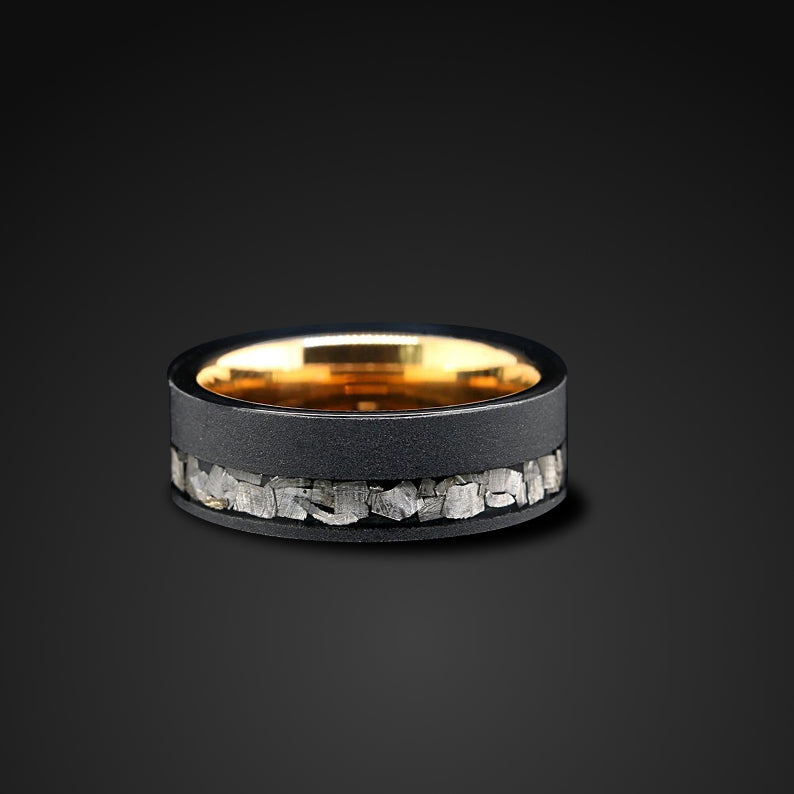
Plain bands are all alike. An inlay is where a pair stops looking like a catalog item. Common choices are meteorite, wood, antler, opal and camo.
Meteorite shows the Widmanstätten pattern, a crystal lattice that formed over millions of years inside the core of an asteroid. Each slice is different, so no two rings look the same. When we make a couples set, both rings can come from one slice, so the pattern runs across the pair. You can read more in our guide to meteorite couples rings.
Width, finish and comfort
- Width. Most people land between 4 and 8 mm. Wider rings show more of the inlay and feel more substantial. Narrower rings are easier to wear all day.
- Finish. Polished is bright and formal. Matte or brushed hides small scratches better and suits an everyday ring.
- Fit. A rounded inside edge (comfort fit) is easier to slide over a knuckle and feels better over a long day.
Sizing without the guesswork
Measure at the end of the day, when fingers are at their largest, and avoid measuring when your hands are cold. If you are between sizes, go up. Remember that wider bands fit tighter than narrow ones of the same nominal size. If you are ordering as a surprise, ask a friend or a family member for a size from a ring that already fits that finger.
If one of you wants an engagement ring too
Many couples choose a three-piece set: an engagement ring and two wedding bands. Check that the bands sit flush against the engagement ring if you plan to wear them together. If you are looking at meteorite for the engagement ring, our meteorite engagement ring guide covers what to look for.
Where to look
Browse our his and hers wedding ring sets, or see all meteorite rings. Not sure which direction fits you two? Write to us and tell us how you wear rings day to day. We make each set to order, so we can adjust width and finish.


